Future industries as new engine for Chinese modernization
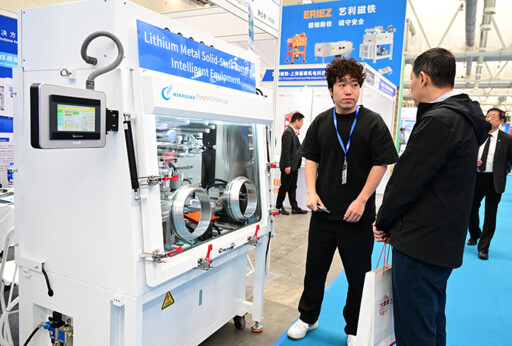
CLNB 2026 New Energy Industry Chain Expo, Suzhou International Expo Center, Suzhou, Jiangsu Province, Apr. 8-10 Photo: IC PHOTO
The outline of the 15th Five-Year Plan (FYP, 2026–30) for national economic and social development calls for “forward-looking planning for future industries.” With global scientific and technological innovation entering an exceptionally dynamic and intensive phase, “future industries” are rapidly transforming innovative potential into forces reshaping the world. In recent interviews with CSST, several scholars noted that China is now at a critical stage of economic transformation and industrial upgrading. How to seize the strategic opportunities presented by the development of future industries within this radically evolving innovation landscape has therefore become a key issue for advancing Chinese modernization.
Representing direction of technological advances
According to Cai Jiming, director of the institute of new quality productive forces at Tsinghua University, the ongoing technological revolution led by artificial intelligence (AI) and the digital economy is broadly and deeply enhancing social productivity through an “AI+” approach.
Li Yiming, deputy director of the Future Industry Research Center at the China Center for Information Industry Development, noted that since 2023, China has witnessed simultaneously accelerated and increasingly interconnected innovation across fields such as general AI, high-level autonomous driving, commercial space, embodied AI, new energy storage, the low-altitude economy, advanced microprocessors, and cell and gene therapy. These developments, she observed, reflect a pattern of multi-point breakthroughs alongside systemic integration.
Future industries, as the core vehicle of new quality productive forces, can break through traditional factor constraints such as land and labor while cultivating entirely new growth drivers, explained Li Shijie, a professor from the School of Economics at Nankai University. In this sense, they serve as a crucial lever for addressing the challenges associated with traditional industrial transformation. Amid the restructuring of global industrial chains, breakthroughs in future industries are also essential for China to overcome weaknesses and achieve technological self-reliance and strength.
Liao Hua, a professor from the School of Management and Economics at Beijing Institute of Technology, argued that building a modern energy system and achieving the “dual carbon” goals—peaking carbon dioxide emissions before 2030 and reaching carbon neutrality before 2060—will require large-scale development of new energy storage technologies. In the near term, he added, investment in energy storage can also stimulate related industries and serve as a lever for boosting short-term economic growth.
Wang Yiming, deputy director of the Wang Yanan Institute for Studies in Economics at Xiamen University, further noted that future industries, through disruptive breakthroughs in cutting-edge technologies, can drive innovative allocation of production factors and modernize the industrial system, thereby injecting core momentum into high-quality development.
Integrating with traditional industries
Mao Yanhua, a professor of economics at Sun Yat-sen University, emphasized that aligning with national strategic needs remains essential for cultivating future industries, calling for a focus on key areas such as AI, quantum information technologies, and biomedicine, alongside increased investment in foundational theories capable of triggering paradigm shifts. He also advocated establishing evaluation systems oriented toward original value and practical contribution, granting researchers greater autonomy over technological pathways.
Sun Jiuwen, a professor from the School of Applied Economics at Renmin University of China, urged systematic efforts to build a basic research system, innovation ecosystem, talent cultivation mechanism, and policy support framework. National laboratories, he suggested, should play a central role, while diverse actors explore multiple pathways to open new avenues for innovation.
Cai further noted that future industries should not be viewed as separate from traditional industries, but rather as their continuation, extension, and upgrading. Regarding this integration, Qu Shenning, a research fellow from the Institute of Industrial Economics at the Chinese Academy of Social Sciences, identified three key areas of focus. First, general-purpose technologies should generate stronger spillover effects, enabling cutting-edge technologies to penetrate the entire chain of research and development, production, and management in traditional industries. Second, traditional industries can leverage their “scenario-driven” role: Their vast data resources and diverse application settings offer ideal testing grounds for future technologies to iterate. Third, traditional industries should be encouraged to incorporate future industries into their value chains through strategic investments or innovation consortia.
Serving national strategic needs
The high uncertainty and cross-sectoral nature of future industries challenge traditional research paradigms built on disciplinary silos and linear development. Mao suggested that academia must adapt through multidimensional transformations in both research paradigms and organizational models. This includes strengthening interdisciplinary integration, improving forward-looking trend analysis, advancing the digital transformation of research methods, and shifting from a mindset of “doing what is feasible with available resources” to one of “doing what is needed.”
While promoting innovation, scholars also stressed the importance of risk prevention. Wang proposed strengthening research in three areas: developing dynamic assessment and early-warning frameworks for technological, market, and ethical risks; embedding ethical norms and national security considerations into the formulation of technical standards and the development of industrial ecosystems; and building agile and resilient governance systems that can prevent major risks without stifling innovation. Cai added that the forward-looking and disruptive nature of future industries places high demands on talent, making reform of education and research evaluation systems inseparable from the broader construction of the entire innovation ecosystem.
