Kites link up to millennia-old Chinese culture
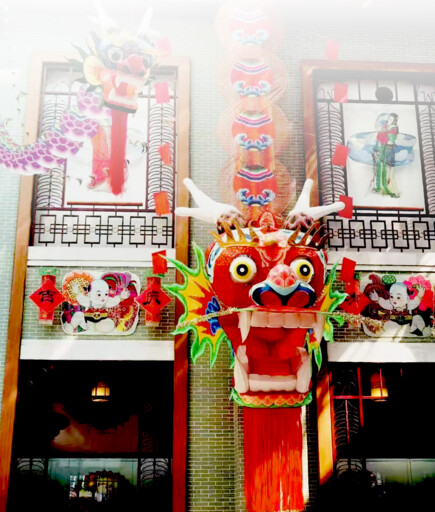
Dragon-headed centipede kites at the World Kite Museum of Weifang, Shandong Province Photo: Rong Zhi/CSST
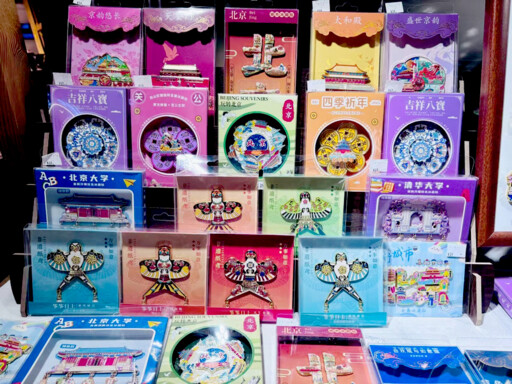
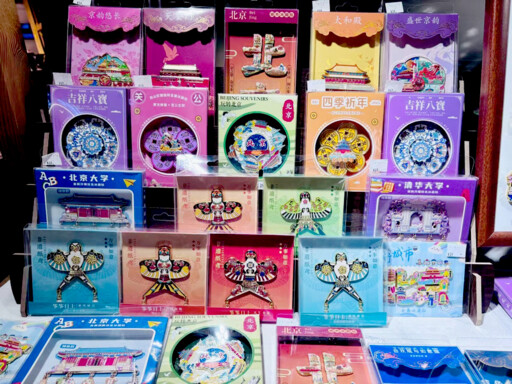
Fridge magnets featuring swallow kites, along with other distinctive symbols of Beijing, at a stall in Euro Plaza, Beijing, on April 12 Photo: Rong Zhi/CSST
Kites have a long history in China. The earliest kites can be traced back to the late Spring and Autumn Period (770–476 BCE). In ancient China, they were known by different names: in the south, yao (harrier), and in the north, yuan (kite)—terms derived from fierce birds of prey such as hawks, hinting at the soaring forms these early kites were meant to imitate.
Origins, evolution
Lu Ban, the master craftsman of the State of Lu during the Spring and Autumn Period, is traditionally regarded as the inventor of kites. According to legend, he drew inspiration from harriers circling in the sky and, using bamboo as a frame, shaped a magpie—known as the wooden magpie—capable of staying aloft for three days. The kite-making techniques he developed were passed down through later generations.
Yet long before Lu Ban, his teacher Mozi had already crafted a wooden kite. According to historical accounts, despite working on it for three years, his contraption crashed on its maiden test flight. Though unsuccessful, Mozi’s wooden kite is widely regarded as the earliest kite prototype in human history.
Over successive dynasties, the craft underwent continuous refinement. After Cai Lun improved papermaking during the Eastern Han Dynasty (25–220), wood was gradually replaced by paper, and kites came to be known as zhiyuan (paper kite).
Lightweight, easy to produce, and difficult to detect once airborne, kites were initially used for military purposes. According to legend, when Han Xin, a general of the early Western Han Dynasty (206 BCE–25 CE), besieged Weiyang Palace—the main imperial palace at the time—he used a kite to measure the distance from his camp to the palace walls, enabling troops to dig tunnels with greater precision.
Another story dates to the Northern and Southern Dynasties (420–589), when Emperor Wu of Liang, Xiao Yan, was trapped in Taicheng by the rebel general Hou Jing. The crown prince, Xiao Gang, attempted to tie an imperial edict to a kite and send it out as a distress signal.
It was not until the Tang (618–907) and Song (960–1279) dynasties—periods marked by economic prosperity, social stability, and the flourishing of festival culture—that kites gradually moved beyond military use and entered everyday life.
Li Ye of the Five Dynasties (907–960) was particularly known for flying paper kites. In a burst of creativity, he added bamboo whistles to his designs, which produced clear, melodious tones resembling those of a zheng (Chinese zither) when wind passed through. From this feature emerged the name fengzheng (kite), which remains in use today.
During the Ming (1368–1644) and Qing (1644–1911) dynasties, kite-making techniques grew increasingly sophisticated, and monographs as well as literary and artistic works devoted to kites began to appear. Renowned writer Cao Xueqin, who mastered the four arts of kite-making—framing, pasting, painting, and flying—authored Nanyao Beiyuan Kao Gong Zhi (A Study of the Craft of Southern Harriers and Northern Kites), which served as a manual for kite making and flying in the capital.
In his famous novel Dream of the Red Chamber, Cao Xueqin also devoted vivid passages to kite flying in the Grand View Garden, where Jia Baoyu, Lin Daiyu, Xue Baochai, and others fly kites of many forms—colorful butterflies, bats, phoenixes, fish, crabs, and elegant ladies. Among them, the seven shayan (swallow) kites stand out for their lifelike forms, soaring and dipping gracefully in the sky.
Used to ward off misfortune
Kite flying was not merely a form of entertainment, but also an expression of the popular wish to ward off misfortune. In folk belief, kites served as a medium capable of carrying away illness and bad luck.
A vivid example appears in Chapter 70 of Dream of the Red Chamber. When Zijuan is about to pick up a kite left behind by others, Lin Daiyu stops her with a smile: “Who knows whose bad luck that’s carrying? Throw it away at once. Bring out ours—let us fly away our bad luck too.” At the mention of flying kites, the maids eagerly set to work. Li Wan then urges Lin Daiyu to join in: “We fly kites for the joy of it, and that’s why it’s also called flying away ill fortune. You ought to fly even more, to carry off your old ailments for good.”
Such scenes reveal that, in the minds of ancient people, kite flying functioned not only as recreation but also as a ritual for dispelling misfortune. This custom survives in some regions today. People write their worries on kites and release them into the sky, allowing troubles to drift away with the wind until they vanish beyond sight. Over time, the tradition has evolved into flying kites outside the door of one’s home, preserving ancient meanings while symbolizing hopes for peace and good fortune.
Influence on modern science, technology
The invention of kites in China also exerted a profound influence on the development of modern science and technology, inspiring numerous scientists and inventors. Benjamin Franklin famously conducted his kite experiment during a thunderstorm, flying a kite with a metal key attached; when lightning struck, sparks appeared on the key, revealing the electrical nature of lightning and ultimately leading to the invention of the lightning rod. Italian physicist Guglielmo Marconi likewise drew inspiration from kites, using a kite line as a radio antenna, with which he successfully tested and transmitted the first transatlantic radio telegraph.
As history has unfolded, kite flying has continued to evolve while preserving tradition. Modern technologies—mechanics, electronics, and remote control—have been incorporated into kite design, producing new variations in form, color, light, sound, and movement—breathing new life into the tradition and allowing this ancient art to bloom anew.
‘Four Major Schools’
Over more than two millennia of development, kite-making gradually split into distinct artistic schools. Among them, Beijing, Tianjin, Weifang in Shandong Province, and Nantong in Jiangsu are widely recognized as the “Four Major Schools” of traditional kite-making, each known for their unique style and exquisite craftsmanship. Their distinctive qualities are often captured in the phrase “Beijing swallows, Tianjin marvels, Shandong butterflies, and Nantong sounds.”
As an elegant pastime originating near the imperial city in bygone days, Beijing kites carry a certain royal aura and high ornamental value, emphasizing harmony between structure and painting. The swallow kite is Beijing’s most representative form: plump or slender, single or in pairs, each displays a distinct posture, resembling swallows darting through clouds.
Tianjin kites are particularly known for their soft-winged designs, with lightweight frames and silk coverings. Their subjects are diverse, often incorporating patterns and motifs from Yangliuqing New Year paintings, with bright yet elegant color schemes. During the late Qing Dynasty and early Republican Era (1912–49), “Kite Wei”—the works of renowned artisan Wei Yuantai—brought this meticulous craftsmanship to its peak.
Weifang kites, rooted in folk traditions, reflect the warmth and simplicity of local Shandong culture. Bold reds, bright yellows, and vivid greens create striking contrasts, while lively compositions convey movement and energy. Butterfly kites are a specialty of Weifang—reflected in the idiom “a hundred styles for a hundred butterflies”—each vying in lifelike detail. The most spectacular, however, is the brilliantly colored dragon-headed centipede kite, whose long, undulating body resembles a mighty dragon gliding across the sky.
Nantong kites form a distinctive school centered on flat banyao (board) kites, celebrated above all for their sound. Large banyao kites are fitted with whistles of varying sizes that sing in the wind, producing layered melodies that drift down from the clouds like a celestial symphony.
Although these four schools differ in form and technique, every kite that rises into the sky carries with it the flyer’s aspirations for a better life. These traditions preserve the warmth of handcrafted culture even as they continue to evolve through innovation. In 2006 and 2008, Weifang, Nantong, Beijing, and Tianjin kites were successively inscribed on the National Intangible Cultural Heritage list, further elevating them as treasured expressions of Chinese culture.
Opening new pathways
Far from fading into history, kite flying has continued to evolve with the tides of Chinese modernization, opening new pathways that bring together cultural heritage, industrial development, and public well-being. Known worldwide as the “Kite Capital,” Weifang has hosted an international kite festival every April since 1984. Celebrated 42 times since its inception, this grand event—combining sports competition, trade cooperation, and cultural exchange—has become the world’s largest and most influential kite festival.
Using kites as a cultural vehicle, Weifang has woven cultural revitalization and industrial development into a collaborative development model—“kites as the link, culture as the stage, and economy and trade as the main act.” Building on this vision, the city has developed a “kite+” modern industrial system, seeking to transform kites from a cultural symbol into a dynamic economic engine.
By continuing to polish its “World Kite Capital” identity, Weifang is writing a distinctive new chapter in the story of Chinese kites.
Song Zhenzi is from the center for studies of oral tradition at the Institute of Ethnic Literature under the Chinese Academy of Social Sciences. Tan Yibin is a member of the China Science Writers Association.