Scholars explore path forward in AI era
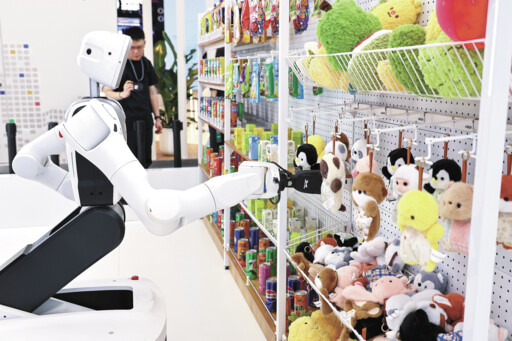
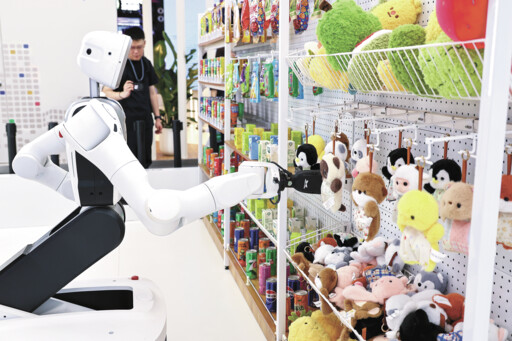
A humanoid robot provides autonomous vending services. Photo: IC PHOTO
At the opening ceremony of the 2026 World Artificial Intelligence Conference and the High-Level Meeting on Global AI Governance in mid-July, Chinese President Xi Jinping, delivered a keynote speech in which he raised questions regarding human–machine relations, security and ethical challenges posed by technology, as well as AI accessibility and inclusiveness. With these questions in mind, CSST spoke with experts in relevant fields about where AI is headed, the social transformations it may bring, and how humanity can guide its development.
From LLMs to AGI
The first phase of AI development can be described as the “large language model (LLM) era.” Yet as model capabilities advance, their limitations are also becoming increasingly apparent. Wu Fei, a professor from Zhejiang University, noted that breakthroughs in specific areas are not enough to demonstrate the emergence of artificial general intelligence (AGI). A genuine leap in intelligence, he argued, would require systems capable of learning across domains, maintaining stable objectives, and generating original insights that can be independently verified.
Future AI research will pivot around five core pillars: scientific data, learning from experience, world models, embodied action, and value systems. Wang Chunhui, a professor from the Institute of China ICT Development and Strategy at Nanjing University of Posts and Telecommunications, explained that LLMs, multimodal models, world models, AI agents, and embodied intelligence operate at different conceptual levels. Each contributes a particular set of capabilities, but no single technological pathway can by itself provide a complete route to AGI. Progress, he suggested, will therefore continue across multiple fronts in parallel.
Along this trajectory, models can provide experimental environments, AI agents can plan and execute tasks, and embodied systems can bring machines into physical space. Once machines are able to understand their surroundings, predict outcomes, and act autonomously, deeper questions arise: Where should their objectives come from? How should tasks be prioritized? And what constraints should govern their behavior?
From human–machine collaboration to societal restructuring
The contours of an AI-driven society are already beginning to take shape, particularly in the changing organization of labor, institutions, and broader social systems.
First, occupational divisions are increasingly giving way to a more granular division of tasks between humans and machines. Guo Yike, an international member of the Chinese Academy of Engineering and provost of Hong Kong University of Science and Technology, predicted that human work will gradually shift toward higher-level activities. How many tasks machines ultimately assume is only one part of the equation; whether workers have opportunities to adapt and whether they share the resulting productivity gains will help determine the broader social consequences.
Second, traditional hierarchies are beginning to evolve into hybrid human–machine systems. Gao Hongbing, director of the Digital Frontiers Research Institute at Shanghai University of Finance and Economics, argued that the large-scale adoption of AI agents could weaken rigid pyramid structures and foster new forms of human–machine collaboration. Autonomous coordination among AI agents may give rise to “super individuals” and smaller organizational units built around intelligent agents. Cui Lili, deputy director of the same institute, suggested that traditional organizations may evolve into either platform-based hierarchies or hybrid human–machine systems. Technology could enable either greater centralization or decentralization, depending on how authority is allocated and accountability maintained.
Third, AI is gradually shifting from a highly visible technological tool to a form of underlying social infrastructure. Lan Jiang, a professor from the School of Philosophy at Nanjing University, argued that large AI models are increasingly becoming embedded in the basic infrastructure of society rather than remaining conspicuous standalone technologies. China, he said, needs to develop corresponding standards for human–machine interaction, technical norms, and industrial systems grounded in its own social settings, cultural context, and industrial needs, while exploring more collaborative and inclusive approaches to sharing data resources.
From open competition, collaboration to pluralistic coexistence
AI is a product of humanity’s collective intellectual development and, in principle, a resource from which all countries should be able to benefit. The Chair’s Statement of the 2026 World Artificial Intelligence Conference & High-Level Meeting on Global AI Governance affirms equal rights, equal opportunities, and equal rules for all countries. This vision acknowledges competition while emphasizing that countries should also have opportunities to access technological systems, develop their own capabilities, and participate in rule-making.
Lu Chuanying, associate dean of the School of Political Science and International Relations at Tongji University, told CSST that when AI models enter different national markets, their deployment should respect each country’s AI sovereignty while taking security, compliance, localization, and long-term service into account as part of an integrated approach.
Hui Zhibin, a research fellow from the Information Research Institute at the Shanghai Academy of Social Sciences and president of the Shanghai Association for AI and Social Development, proposed that countries should strengthen their own technological capabilities while maintaining cooperation in areas such as safety evaluation, technical standards, risk notification, and capacity building. The aim, he suggested, should be a more interconnected innovation landscape with multiple centers of technological development.
From AGI to superintelligence
The outlines of a path toward AGI are already visible, but the journey from general intelligence to superintelligence presents a still greater challenge. Four possible routes have emerged: continuing to scale computing power, models, and data; developing new algorithmic paradigms; recursive self-improvement, where AI iteratively optimizes its own architecture; and fostering large-scale collaboration among multi-agent systems that could give rise to collective superintelligence. These pathways are not mutually exclusive and may develop simultaneously or intersect.
Yang Qingfeng, a professor from the Institute of Technology Ethics for Human Future at Fudan University, warned: “The greatest risk posed by superintelligence lies not in malicious intent, but autonomous operational logic. Even under perfect value alignment, unconstrained execution of human-set objectives could potentially reset human civilization.”
AI must remain a trustworthy tool, subordinate to humanity and permanently under human control. Qiao Baojie, a professor and dean of the School of Law at Shanghai University of International Business and Economics, argued that the principle of “human leadership, AI assistance” requires humans to remain in the leading role, with AI occupying a subordinate and instrumental position and final decision-making authority remaining with human actors.
Why is human control non-negotiable? Cheng Lesong, dean of the Department of Philosophy and Religious Studies at Peking University, put the issue more starkly: “We must uphold human subjectivity, for we still possess the capacity to do so today.”
Mo Bin, Wang Guanglu, He Diya, and Zhang Sai contributed to this story.